Microfluidics case study
Available (limited)Microfluidic cell-sorting chip design
Separating cells by size and deformability without labels is a core microfluidic capability. A demanding case is isolating circulating tumor cells (CTCs, roughly 17-20 um) from the whole-blood background (red cells ~7.5 um, white cells ~12 um). Octara sizes these separations against a cited cell library and simulates the streams.
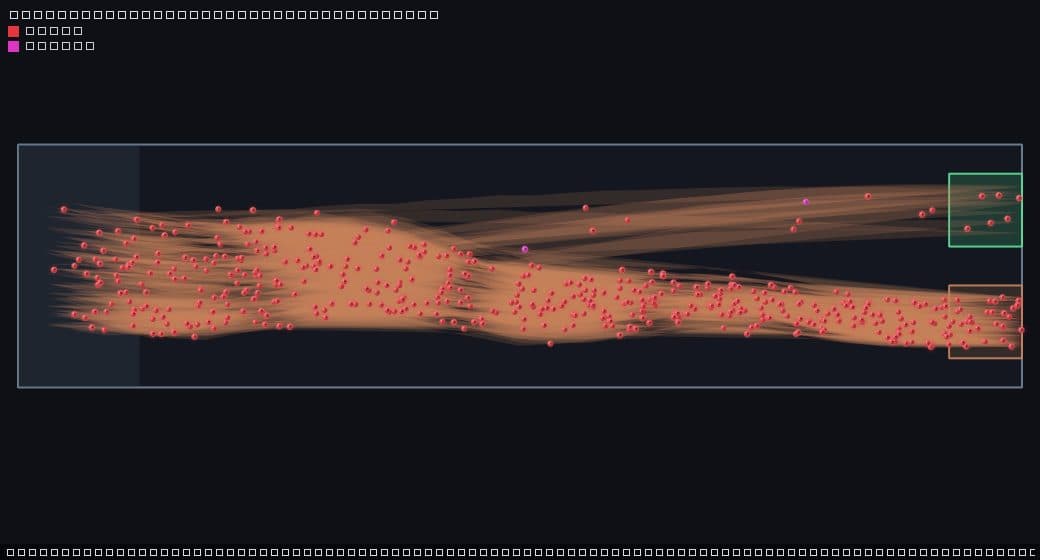
The problem
A size-based sorter must push large and small cells onto different streamlines and keep them there to distinct outlets, in a background that is crowded and deformable.
Architecture
- Passive size-based methods: inertial spiral (Dean-flow focusing), deterministic lateral displacement, or pinched-flow fractionation.
- A cited cell library sets diameters, density and deformability.
- Outlets are placed at the focused-stream positions for large vs small cells.
Assumptions
- Dilute suspension, size-based cutoff
- Laminar carrier flow
- Particles follow streamlines except for inertial / Dean migration
Model
Inertial focusing scales with the particle Reynolds number; a curved channel adds a Dean secondary flow that focuses particles by size; the geometry is tuned so the target size lands on a different outlet from the background.
Particle Reynolds: Re_p = rho U a^2 / (mu D_h)Dean number: De = Re * (D_h / 2R)^(1/2)Separation: size cutoff a* placing large cells (CTC) and small cells (blood) on different streamsSimulation results
- Distinct outlet streams for large versus small cells in the simulated separation.
- The design is sized against real cell diameters, not arbitrary values.
- Flow and residence time are checked with the lumped-hydraulic solver.
Limitations
- Size overlap (large white cells vs small CTCs) limits achievable purity.
- Deformability, clogging and hematocrit matter and are not fully captured.
- Predictions are computational - validate with spiked samples and imaging.
Try it in the free Studio
Build a network like this and solve it for pressure, flow and Reynolds number in your browser - the same lumped-hydraulic model, no account needed.
More microfluidics case studies