Microfluidics case study
Available (limited)AI-assisted microfluidic design
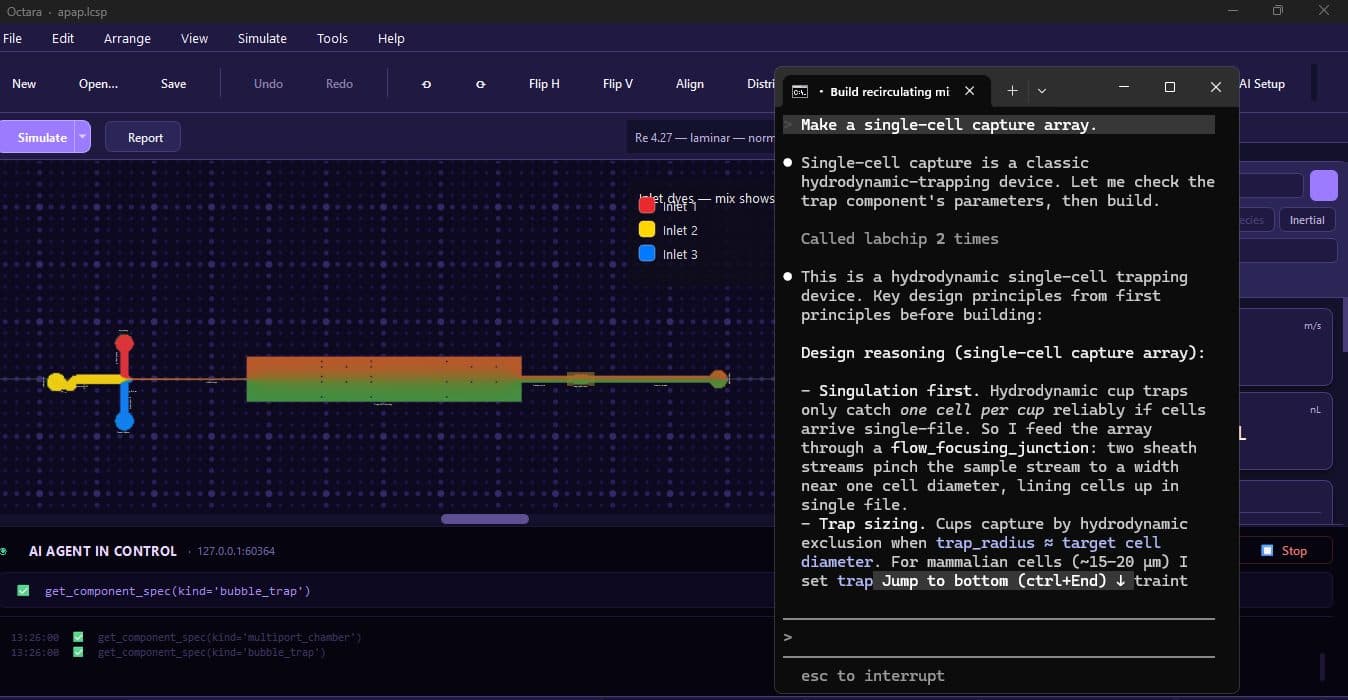
Going from an assay idea to a manufacturable chip layout is expert, slow work. Octara's Prompt Studio turns a described objective into an editable architecture. Importantly, the language model is an orchestration layer - it interprets intent and explains the result; it does not compute the physics or invent geometry.
The problem
A useful design tool must produce something you can inspect and change, not a black-box image. The hard part is turning intent into real, parametric components placed and routed without overlaps or rule violations.
Architecture
- The language model interprets the objective and selects real parametric components.
- A layered placement engine (Sugiyama-style) positions components with crossing minimisation.
- A maze / A* router wires the channels with rip-up-and-reroute.
- Design-rule checks catch overlaps and spacing violations.
- The result is an editable design you then simulate with the lumped-hydraulic solver.
Assumptions
- Every generated element is a real component with inspectable parameters.
- The design is a starting point to edit, not a final answer.
- Physics is computed by the solver, not the language model.
Model
The pipeline is deterministic where it matters: objective -> component selection -> layered placement -> channel routing -> design-rule check -> editable architecture -> hydraulic simulation. The assistant narrates and routes; the engines place, route and solve.
intent -> components -> placement -> routing -> DRC -> editable design -> lumped-hydraulic checkSimulation results
- Generates gradient generators, droplet systems, mixers, manifolds and multi-chamber networks as editable designs.
- Each component remains parametric - widths, depths and lengths are yours to change.
- The design drops straight into the simulator to check flow before fabrication.
Limitations
- Assists the engineer; it does not replace design judgment or domain review.
- Generated layouts are starting points - edit, simulate and validate them.
- Manufacturability still depends on your process and tolerances.
Try it in the free Studio
Build a network like this and solve it for pressure, flow and Reynolds number in your browser - the same lumped-hydraulic model, no account needed.
More microfluidics case studies